The Anatomy of the Unconventional: How Sculptural Packaging and AI Still Photography are Rewriting the Rules of DTC Beauty Branding
May 28, 2026
Introduction
In the rapidly evolving landscape of Direct-to-Consumer (DTC) beauty, visual presentation has transcended its traditional role to become a paramount driver of brand recall and consumer loyalty. The physical form of a product, coupled with its photographic representation, is now as critical as its clinical efficacy in securing market dominance. This blog post delves into the visual revolution defining the 2026 DTC beauty landscape, using the Indian beauty brand Dot & Key as a compelling case study. We will explore how Dot & Key has masterfully leveraged "Sculptural Packaging and Tactile Visuality," heavily supported by hyper-stylized still photography, to carve out a significant niche. Furthermore, we will examine how AI photography can democratize this high-end aesthetic, enabling emerging and established brands to achieve globally resonant, high-converting visuals without the prohibitive costs and logistical complexities of traditional photoshoots.
The Strategic Rejection of Legacy Aesthetics: Dot & Key's Mastery of Structural Form
The Indian beauty and personal care market is experiencing a profound aesthetic evolution, projected to grow at a robust Compound Annual Growth Rate (CAGR) of 10–12% through 2026, potentially reaching an estimated $48–49 billion by the mid-2030s. Historically, domestic skincare brands often relied on heavily text-laden, cylindrical packaging, primarily designed for physical pharmacy shelves or traditional retail environments, conveying a utilitarian and clinical visual language. Dot & Key, founded in 2018 by Anisha Agarwal Saraf and Suyash Saraf, systematically dismantled this outdated paradigm. The brand introduced visual branding that operates at a global, premium standard while maintaining deep regional resonance and approachability.
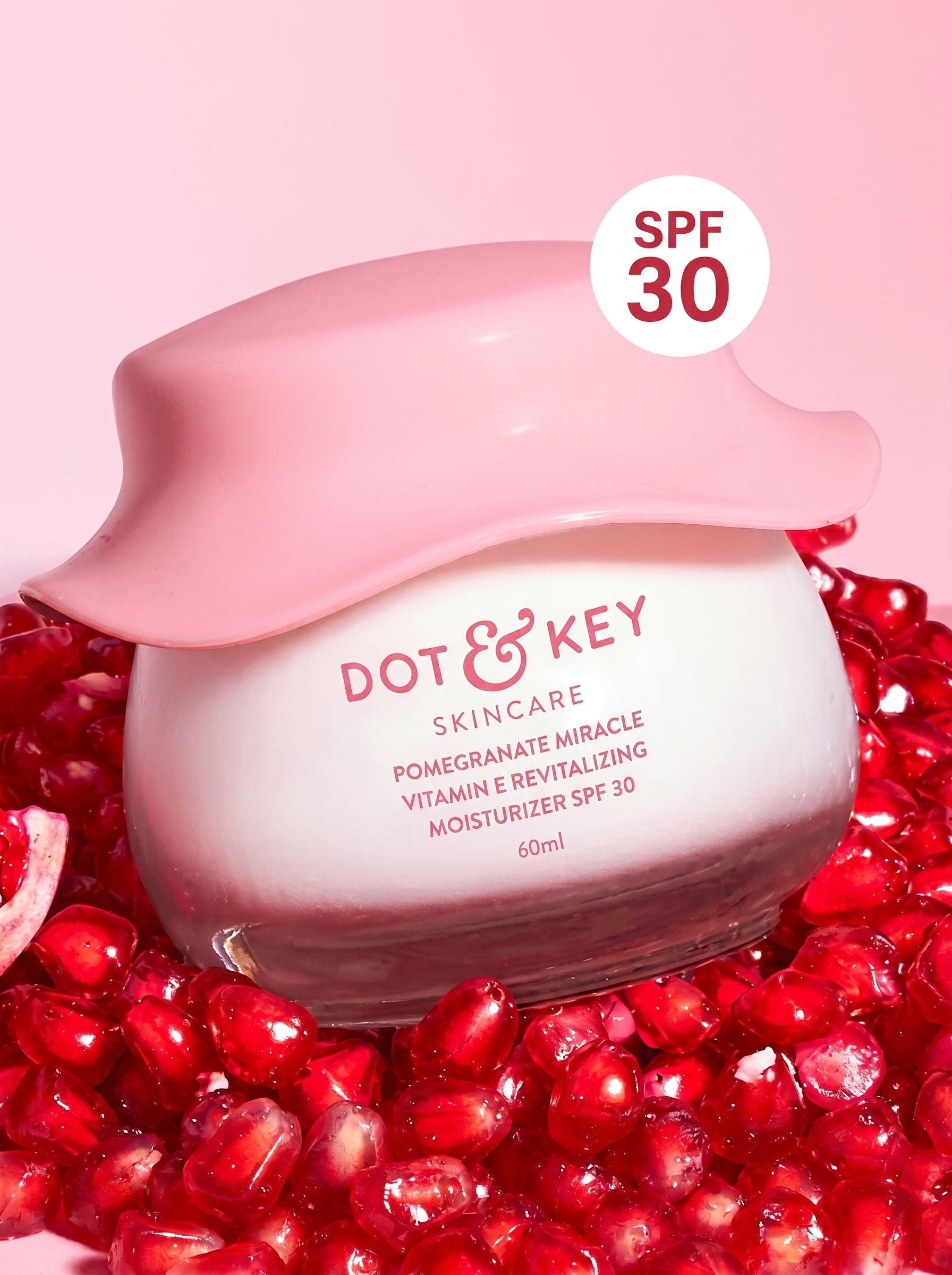
At the core of Dot & Key's market disruption is its structural packaging strategy. Aligning seamlessly with the 2025-2026 global macro-trend of "sculptural packaging" and biomimicry, where primary packaging assumes a totem-inspired aesthetic, Dot & Key utilizes distinctive orb-like, bulbous, and egg-shaped silhouettes. These unconventional shapes act as immediate pattern-interrupts in a saturated digital feed. When consumers scroll through highly compressed digital environments, spherical and asymmetrical designs reject the symmetry and familiarity of traditional bottles, compelling the human eye to pause and process the visual anomaly. The packaging itself transcends its functional role, becoming the primary brand signal.
This structural uniqueness is meticulously supported by a carefully defined secondary visual identity, executed by specialized design agencies like Studio Glyph. The brand employs a strict, pastel-driven color palette—notably mint, powder blue, and sunshine yellow—which softens the clinical nature of their active ingredients, making advanced skincare approachable. Furthermore, the typography blends sophisticated serif and sans-serif fonts, rendered with silver foil detailing on outer cartons, to project modern luxury. Industry research validates this approach; studies by the Foil & Specialty Effects Association demonstrate that packaging with foil embellishments is rated over 80% higher in perceived quality, appeal, and brand awareness compared to non-foil alternatives.
The financial imperative of this visual consistency is undeniable in the modern DTC landscape. Current market analysis reveals that businesses maintaining a unified, highly recognizable visual identity across all digital and physical platforms experience up to 20% greater overall growth and a 33% increase in revenue compared to competitors with inconsistent or fragmented branding. The cognitive processing of visual appeal occurs in a mere 50 milliseconds. If a brand's visual identity fails to communicate trust, efficacy, and modern luxury within that microscopic fraction of a second, the consumer disengages, irrespective of underlying product quality or clinical backing.
Dot & Key's recent Vitamin C + E Super Bright Sunscreen campaign, featuring brand ambassador Shanaya Kapoor, exemplifies leveraging this visual equity to drive market dominance. Instead of launching a completely new formulation for seasonal summer sales, the brand centered a massive, multi-channel marketing push entirely around a "refreshed look" and updated packaging of an existing, proven product. The campaign deliberately moved away from unattainable, high-fashion "glossy" aesthetics, focusing instead on everyday, relatable scenarios. The narrative strategically juxtaposed the fun, pastel aesthetics of the sculptural bottle with rigorous scientific claims, placing "in vivo testing" at the forefront to prove SPF 50 PA++++ protection, the efficacy of Sicilian Blood Orange, and collagen support. By placing the physical, newly designed bottle at the center of the visual narrative, Dot & Key effectively communicated that the aesthetic experience of the product is inherently tied to the confidence and emotional impact it delivers. This strategy underscores a vital lesson for DTC marketers: when the physical product is designed as a sculptural piece of art, its visual documentation—specifically high-end still photography—becomes the most potent marketing asset for generating consumer recall and driving acquisition.
E-Commerce Still Photography Standards and the Visual Psychology of Conversion
While structural packaging provides the foundational architecture for brand differentiation, the translation of that physical, three-dimensional object into a two-dimensional digital space is what ultimately drives e-commerce conversions. In the DTC sector, where physical tactile interaction is impossible prior to purchase, still photography must bear the entire burden of sensory communication. Quantitative research consistently indicates that 90% of consumers consider visual appearance the primary deciding factor in digital purchases. Therefore, photographic execution must be flawless.
Dot & Key's approach to e-commerce and campaign photography is a highly sophisticated exercise in visual psychology. The brand's imagery strictly avoids the clinical sterility of pure white-background packshots, opting instead for stylized, conceptual still lifes that communicate context, texture, and emotional resonance. The photographic execution relies heavily on precise lighting techniques tailored specifically to their unique, bulbous bottle shapes. Photographing highly reflective or matte-pastel objects with unconventional forms is notoriously difficult in traditional studio settings. Standard, direct lighting often creates harsh, blown-out reflections on curved surfaces, destroying the perception of volume.
To counteract this, the prevailing global aesthetic demands soft, highly diffused lighting—often simulating natural window light or utilizing expansive studio softboxes that wrap light evenly around the object. This specialized technique produces smooth, continuous specular highlights that perfectly define the volumetric shape of the orb or egg silhouette, emphasizing its tactile, pebble-like, and biomimetic quality. The subtle gradient of light across the curved surface signals premium quality to the human eye, establishing the product as a modern heirloom rather than a mass-manufactured commodity.
Furthermore, the brand heavily utilizes ultra-crisp macro photography to visually substantiate invisible chemical claims. For a flagship product like the Vitamin C + E Super Bright Sunscreen, marketing claims center on its "waterlight liquid texture," a "non-sticky" feel, and the absolute absence of a "white cast" on diverse Indian skin tones. To communicate these claims visually without relying on text, macro photography captures the viscosity, translucency, and spreadability of the formula on conceptual surfaces or human skin. These extreme close-up macro textures provide immediate visual social proof, backing up the clinical "in-vivo testing" claims central to their 2026 marketing narrative.
The strategic importance of high-quality, high-resolution still imagery is further validated by an analysis of current social media consumption metrics and algorithmic preferences. While short-form video content drives broad reach and initial top-of-funnel discovery, static still photography—particularly Instagram Carousels—remains the overwhelmingly dominant format for deep engagement, education, and long-term memory retention. Platform data from 2026 indicates that Carousels consistently earn the highest number of "saves" among all post types, regardless of account size or follower count. A "save" is a critical, high-intent action, indicating that the consumer finds the visual information valuable enough to bookmark for future reference, making it a more reliable metric for long-term brand recall and eventual conversion than passive metrics like "likes" or "impressions." By populating these high-retention carousels with visually arresting still lifes—featuring their sculptural packaging bathed in soft light, accompanied by custom iconography that simplifies complex scientific formulations—Dot & Key systematically reduces cognitive friction for the consumer. They masterfully balance the "relatable storytelling" demanded by younger demographics with the "science cues" required to establish dermatological credibility. This methodology, where pristine image quality and deliberate lighting subconsciously imply formulaic superiority, is the absolute standard all emerging and scaling DTC beauty brands must achieve to compete in a globally unified aesthetic landscape. It is the visual embodiment of "trusted simplicity."
Replicating and Elevating Global Aesthetics via AI Photography
The visual standards established by market leaders like Dot & Key present a significant, often insurmountable barrier to entry for emerging and mid-tier DTC brands. Orchestrating traditional, physical photoshoots capable of delivering this specific level of hyper-realistic, conceptually styled imagery is fraught with logistical complexities. It requires specialized lighting technicians to manage reflections on bulbous packaging, expensive macro lenses to capture fluid textures, bespoke prop styling to convey an aura of "trusted simplicity," and extensive post-production retouching. This traditional paradigm involves prohibitive capital expenditures, extended production timelines, and immense logistical rigidity.
This operational bottleneck is precisely where an elite AI visual studio transitions from a technological novelty to a critical commercial necessity. For performance marketers, creative directors, and founders seeking to replicate the global aesthetic dominance of sculptural packaging and premium clinical styling, AI-generated still photography offers an unparalleled strategic advantage, providing perfect execution of static imagery without the constraints of physical production.
The technical application of AI in this specific cosmetic context is highly specialized. When generating still imagery for products with unconventional, complex geometric shapes—such as the orb-like and egg-shaped bottles favored by modern biomimetic brands—advanced AI models can be prompted to calculate exact light refractions, global illumination, and subsurface scattering algorithms. An AI visual studio can program precise, mathematically perfect environmental parameters. For example, prompting for "soft natural window lighting, morning sunlight, highly diffused through sheer linen curtains, casting a gentle, volumetric, continuous specular highlight on a [product]" allows for unparalleled control and consistency. This capability ensures that every visual asset perfectly aligns with the desired aesthetic, regardless of the product's complexity or the brand's budget. AI photography thus enables DTC brands to achieve the globally resonant, hyper-realistic aesthetic seen in leading brands like Dot & Key, at an unprecedented scale and efficiency.
Conclusion
Dot & Key's remarkable success in the Indian DTC beauty market is a testament to the transformative power of strategic visual branding. By embracing sculptural packaging and meticulously crafted still photography, they have not only differentiated themselves but also set a new benchmark for aesthetic excellence. The brand's ability to communicate trust, efficacy, and modern luxury through visual cues alone highlights the critical role of high-quality imagery in driving consumer engagement and conversion in the digital age. For DTC beauty brands aspiring to replicate this level of visual dominance, the path forward lies in leveraging innovative solutions. BM Arena's AI photography services offer a powerful avenue to achieve globally resonant, hyper-realistic aesthetics, democratizing access to premium visual content and enabling brands to captivate their audience without the traditional overhead. Elevate your brand's visual strategy and unlock unparalleled growth in the competitive beauty landscape.